Exercise, Fitness Goals

How to Stay Fit During the Jewish High Holidays

How to Stay Fit During the Jewish High Holidays

Oftentimes we think there’s so much to do to in the days and weeks preparing for the Jewish High Holidays that we simply won’t have time for exercise.

Even the most disciplined women find it difficult to maintain their exercise routines due to schedule and eating changes during Rosh Hashanah, Yom Kippur, and Sukkot.

As a personal trainer, even I struggle with keeping up my exercises during this time. However, it can be done. I’m going share the strategy and mindset that my training clients and I use. It’ll help you emerge renewed and re-energized about working out.

Set workout goals for the year

My religious teachers recommended using a notebook dedicated to logging what spiritual changes I wished to make in the coming year before each Rosh Hashanah.

I also track similar goals for my nutrition and exercise in a notebook. With your objectives in writing, you can re-read and re-evaluate them during the year to keep yourself accountable.  

Schedule your workouts

Source: Bendiful Blog

I put my workout into my schedule as if it were any other kind of appointment. If your lifestyle defies regular appointment style scheduling, do your exercise intermittently around the tasks of the day.

For instance, perform 10 squats at the top of every hour, or three modified push-ups before switching cleaning tasks. If you don’t have time for a regular 30-60 minute workout, know that even 5-10 minutes of exercise in a day is better than nothing.

Work out whenever, wherever
You do not need a gym in order to work out! My favorite exercises when I’m in a time crunch are body weight based moves like push-ups, planks, crunches, and squats because they can be done virtually anywhere, with minimal space, and no equipment.

Walking while introspecting is a great way to prepare for the seriousness of the Jewish High Holidays, and getting outside in the sunshine is one of the best ways to reset your internal clock and lift your mood.

Work out with the family

Source: Today

Got kids? Jump rope and tag can be fun full-family activities. Hiking, biking, and boating are ways to stay active on Chol HaMoed followed by stretch out time in the Sukkah.

Give yourself some slack

One of the beautiful things about the Jewish tradition is that by observing the holidays we’re practically forced into some degree of moderation which is, in itself, a key to good health. Know it is OK to take a break! Our creator made us perfectly imperfect. Nobody stays on track all the time.

If your exercise needs to take a break for a few days or you eat a little more, don’t beat yourself up about it. Instead, remind yourself that taking care of your health by exercising is a way to show yourself love, not to punish yourself, and get back on track as soon as you can.

Now, here are some exercise ideas for the Jewish High Holidays.

Squat

Begin standing with feet facing forward. Legs shoulder width apart.

Shift your weight into your heels and inhale as you sit into an imaginary chair. Working within your comfortable range of motion, try to get your thighs parallel to the floor while keeping your knees behind your toes. Exhale as you stand to complete the movement.

This exercise strengthens the top of the thighs and buttocks.

To progress this exercise to a more advanced/level 2 option, it can be performed as a Jump Squat instead. Begin as above. Standing. Feet shoulder width apart. Shift weight into your heels. Inhale as you sit into an imaginary chair. Aim to make your thighs parallel to the floor. Don’t be shy about sticking your butt out to keep your knees behind the toes. Exhale as you jump.

Bridge

This exercise targets the hamstrings and glutes. Begin lying on the floor on your back. Feet flat on the floor. Legs hip width apart. Exhale as you squeeze your glutes and raise your hips off the floor. Inhale as you lower the hips back toward the door low enough that you could slide a piece of paper between your tush and the floor but don’t let your tush hit the floor. Repeat.

Plank

Planking targets the core. Begin prone (on your tummy). Elbows directly under shoulders. Toes flexed ball of the foot on the floor. Exhale as you draw your belly button toward your spine. Create space under your arm pits. Firm your glutes. Relax the shoulders back and down away from your ears. Lengthen through the crown of the head. Keeping ears, shoulders, hips, and knees on one straight line breathe steadily and evenly. Hold this posture for 8-30 seconds.

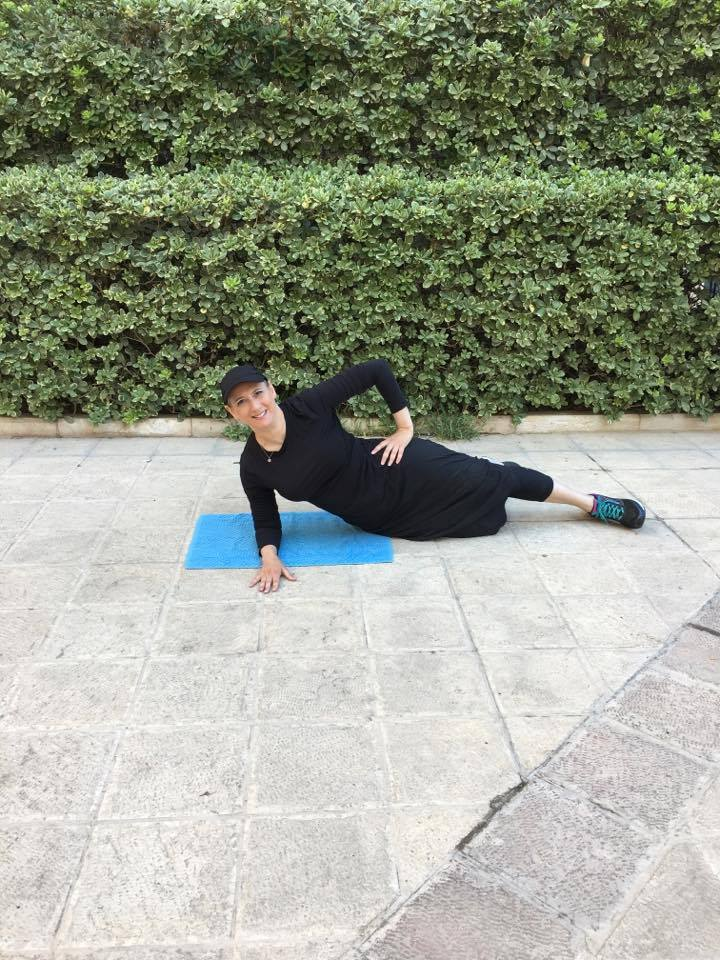
Side Plank

Side planking targets the obliques. Also works shoulders. Begin side-lying. Elbow directly under shoulder. Hips and knees stacked. Bottom leg bent. Top leg straight with foot on the floor. Spine in neutral.

Exhale as you lift the hips off the ground. Keep your abs engaged. Create space between your ribs and the floor. Leave the bottom knee and the top foot pressing onto the floor as you maintain your hip lifting. Inhale back to start. Repeat. Lifting and lowering the hip. Repeat on other side.
Modified Push-Up

Targets the anterior deltoid/front of the shoulder. Triceps/back of the arm and pectoralis major/chest. Begin on all fours/in tabletop position – hands and knees on the floor. Hands wider than shoulder width and fingers spread. Hands are about parallel to shoulders. Keeping your belly button drawn in toward your spine, shift your hips forward so your ears, shoulders, hips, and knees form one straight line.

Inhale as you bend at the elbow lowering your body toward the floor. Aim to lower the body such that a small orange could fit between your chest and the floor. Exhale as you straighten the elbows and push back up to start. Keep your spine in neutral by drawing your belly button toward your spine throughout this movement. Do not allow the low back to sag.

Keep ears, shoulders, hips, and knees in one straight line from beginning to end during this movement.

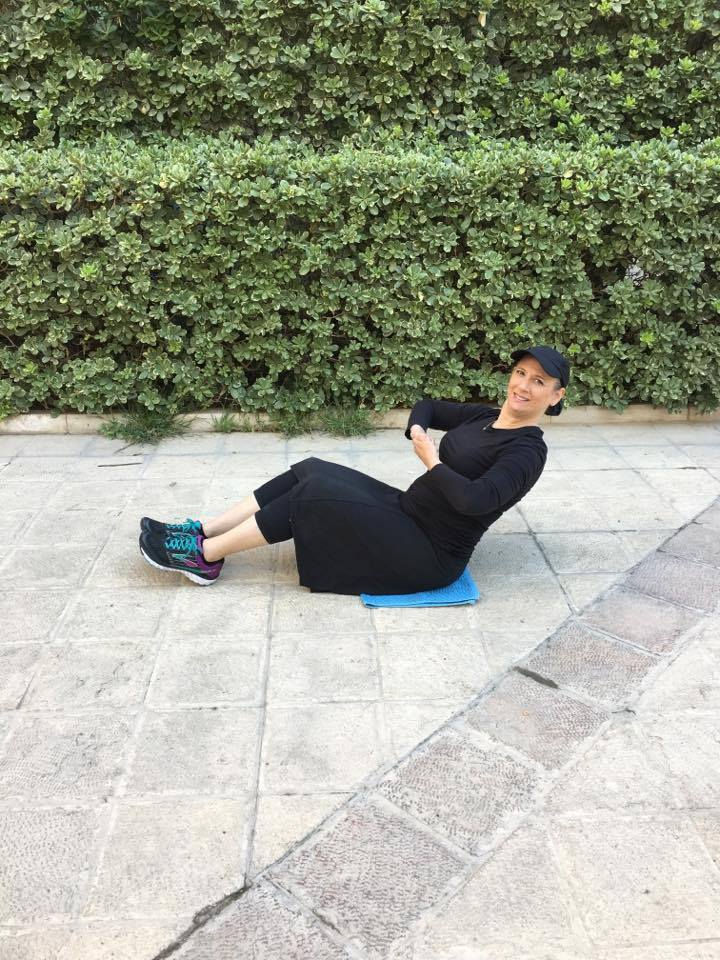
Seated Twist

Targets the abs. Begin seated. Heels on the floor. Legs together. Knees bent. Interlock your hands. Lean back with a neutral spine until you feel your abs engage. Twist slowly side to side.
Getting started

These six exercises work the major muscle groups with a focus on abs. They can be performed consecutively for 8-12 repetitions each as a complete circuit. Alternatively, they could also be performed with a timer for 30-45 seconds per exercise with a 10-15 second break between exercises. Be sure to listen to your body. Take it at your own pace and modify as necessary.

This circuit is designed for ladies without knee and/or low back issues. Always listen to your body. Check with your doctor before beginning any exercise program.

Happy working out!

Originally published in Jewess Magazine on י״ז באלול ה׳תשע״ז September 8, 2017

Uncategorized

Surprising Benefits of Exercise During Pregnancy

Exercise is an important part of a healthy lifestyle, and this is especially true during pregnancy. Regular exercise during pregnancy can provide numerous benefits for both the mother and the fetus. In this blog post, we will explore the benefits of exercise during pregnancy and provide tips for exercising safely.

Benefits of Exercise During Pregnancy

  1. Improved overall health: Exercise can help to maintain a healthy weight, reduce the risk of gestational diabetes and hypertension, and improve cardiovascular health.
  2. Reduced risk of cesarean delivery: Women who exercise during pregnancy may be less likely to require a cesarean delivery.
  3. Reduced risk of preterm birth: Regular exercise during pregnancy has been associated with a lower risk of preterm birth.
  4. Reduced risk of pregnancy complications: Exercise can help to reduce the risk of pregnancy complications such as preeclampsia, gestational diabetes, and preterm labor.
  5. Improved mood and reduced stress: Exercise has been shown to improve mood and reduce stress, promoting a healthier pregnancy and potentially easier labor and delivery.
  6. Reduced pregnancy-related discomfort: Exercise can help to alleviate common pregnancy-related discomforts such as back pain, constipation, and fatigue.
  7. Healthier fetal growth: Exercise during pregnancy has been associated with healthier fetal growth and development.

How to Exercise Safely During Pregnancy

Before starting or continuing an exercise program during pregnancy, it is important to consult with your healthcare provider. Your provider can help you determine which exercises are safe and appropriate for you based on your health status and the stage of your pregnancy. Here are some general guidelines for safe and effective exercise during pregnancy:

  1. Start slow and gradually increase the intensity of your workout: If you were not active before pregnancy, start with low-impact activities such as walking or swimming and gradually increase the duration and intensity of your workouts.
  2. Choose low-impact exercises: Low-impact exercises such as walking, swimming, cycling, or prenatal yoga are generally safe for most pregnant women.
  3. Stay hydrated and avoid getting overheated: Exercise in a cool, well-ventilated environment, and wear breathable clothing to avoid getting overheated. Drink plenty of water before, during, and after exercise to stay hydrated.
  4. Some doctors suggest avoiding exercises that require you to lie flat on your back after the first trimester, because it can compress the vena cava, cause nausea, dizziness and reduce blood flow to the fetus and the mother’s brain. Others say that for short periods of time its not an issue. So check with your doc.
  5. Listen to your body and adjust your exercise routine as needed: If you experience dizziness, shortness of breath, increased discharge or vaginal bleeding, stop exercising immediately and contact your healthcare provider.

Benefits to the Fetus

Regular exercise during pregnancy can promote healthier fetal growth and development. Studies have shown that exercise during pregnancy can lead to improved fetal oxygenation, increased placental weight, and reduced risk of fetal distress during labor. Additionally, babies born to mothers who exercised during pregnancy may have better cardiovascular health and improved cognitive function later in life.

In conclusion, regular exercise during pregnancy can bring numerous benefits for both the mother and the fetus. However, it’s essential to exercise safely and appropriately during this time to ensure the health and well-being of both. Talk to your healthcare provider about which exercises are safe for you, and listen to your body to make adjustments as needed. By staying active during pregnancy, you can help to promote a healthier pregnancy and potentially easier labor and delivery.

Exercise, Fitness Goals, General Health, Motivation

Let’s Get Moving: 5 Tips for Getting Back into Fitness

Help, I’ve Fallen off the Exercise Wagon

Screen Shot 2019-10-28 at 11.23.11 PM
How to Ease Back Into Fitness

If you just spent the last month like I did: (a) With a piece of honey cake in one hand and a cup of coffee in the other, (b) Doing an exercise routine exclusively made up of balancing hot dishes on one arm while walking laps in and out of the house, (c) where regeneration activity included multiple hours seated in meaningful contemplation or reading, or… (d) All of the above, plus sullen concerns about your lack of energy and expanding waistline…Then you will want to read on about how to bounce back into working out.

First: Let’s get real about expectations. You will want to pick up where you left off. This generally means you will want to return to the couch (Remember a body at rest tends to stay at rest from physics class in High School?!?) or, You will want to become the quintessential weekend warrior and jump headlong into intense cardio and double sessions in the gym. I want to take this moment to help you pause and do neither of those instinctive but completely unproductive impulses.

Instead, follow my

5 tips for getting back into exercise and fitness in a sustainable way:

1. Prepare for success. Lay your workout clothes and sneakers out before you go to bed. Schedule the workout in your planner and block out interruptions. Do that workout before you have time to think about it…because thinking during the next two weeks (your break back in period) will only get in your way. We want this on auto-pilot because deciding to work out and actually getting there is the hardest part. Short-circuiting the decision part is key. So stack that workout habit on top of some other firmly established habit (like waking up in the morning) and do it in a way that keeps it front of mind- i.e. having the sneakers in your visual space or the phone appointment alarm.

2. Begin the way you mean to go on. Plan on ONE thing you can stick with consistently FOREVER. Maybe that’s a 10 minute walk. Maybe that’s a 10 minute walk three times a week. Maybe that’s a 10 minute walk plus 20 situps and 10 modified pushups and a stretch. Pick that one thing you could reasonably, easily stick with for the rest of your life… and do it consistently for the next two weeks.

Resist the urge to give 110% these first two weeks. You want to work out to a point where you notice there was something happening but not so sore you can’t move (and sometimes you can’t tell because soreness doesn’t kick in until 24-48 hours after, so it’s ok to do a little less than you think you can that first time.) This is NOT the time to push your limits. You do not want to miss a workout these first two weeks. Consistency IS success. Soreness is not the indicator of success. I’m fairly certain you didn’t plan to go on needing to hold onto the walls easing yourself onto the toilet because …leg day.

3.Figure out your WHY and write that down. Why do you want to get fit? Want to not die so soon? Write it down. Want to look awesome for your niece’s wedding. Write it down. Need to get up the stairs without passing out? Whatever that “WHY” is, figure it out now, and write it down. Read what you wrote down often. Put it in your phone. Make a collage about it. When you have a meaningful reason, you can withstand the discomfort of making space in your life to commit to it.

4. Have Fun. The more fun you have while doing the workout the more you will stick with it. Maybe you fell off the wagon because you were bored. Then try something new- a new class, a new sport, something which used to make you smile but you gave up years ago like dancing in your bedroom like Madonna to show tunes.

5. Get support. Need a sports bra, get it. New sneakers? Need to dial a friend, a counselor, a coach, a trainer? You can’t do this alone. You need support so plan that out. Register for a class or take that walk Wednesday with a friend. Call a trainer or a sports med doc or a physical therapist if needed, so you can move better.

Periods of time off can break a plateau and even help reinvigorate your excitement and desire to exercise. Observing the Jewish holidays practically enforces a degree of moderation, and even regeneration (a key component of fitness), so don’t sweat it. It’s an overall sedentary lifestyle that becomes detrimental for our wellbeing but following these tips will allow you to ease back into sustainable exercise.

—–

Another version of this article appeared in LA Jewish Home October 20, 2022 (a newspaper serving the Greater Los Angeles Jewish Community)

Fitness Goals, General Health, Motivation

End of Summer thoughts

The end of summer/beginning of the school year brings such mixed emotions. 

This time happens to be the Jewish month of Ellul/the pre-High Holiday preparation time. We start to reflect on all of the things we have done and all we wish to accomplish in the coming year. We sometimes create grand goals like this year I will be able to fit into my (spectacularly smaller) outfit. This year I will become more fit (amorphous goal). Or this year I’ll eat healthy (whatever that’s supposed to mean..and often its overly restrictive and not sustainable long-term and will later boomerang back on your body and diminish your self-worth).

There’s a reason we’re not already there in that best bod ever right now. There are habits and skills that need to be established that maybe never have been or the pandemic blew to pieces as we simply coped. I am writing to caution you that as tempting as it is to do an accounting and draft big expectations with the thought maybe you will fall short of those huge goals but still progress will be achieved, you’re likely to be more successful with a different approach.

Let me challenge you to think first about which habits and skills need to be up to snuff in order to accomplish those grand goals and instead of focusing on the outcome, focus on the process- on becoming that version of you who does and thinks and eats like the person who has the outcome you desire.

Consider what baby step could be taken this week that is so small that its barely noticeable but takes you in the direction you want to go. Can you do that just for this month to show the universe this is who you are so the universe (insert your higher power here) can then assist? Would incorporating one vegetable into lunch or drinking a glass of water or simply slowing down to notice the taste of your food (but not all 3) be that thing? Would walking for 5 minutes be that thing? What 1 thing could you do right now and stick with forever? Think small and start..now! Need help? Go to the tab above that says contact me and we’ll make a workable plan.

Fitness Goals, Motivation

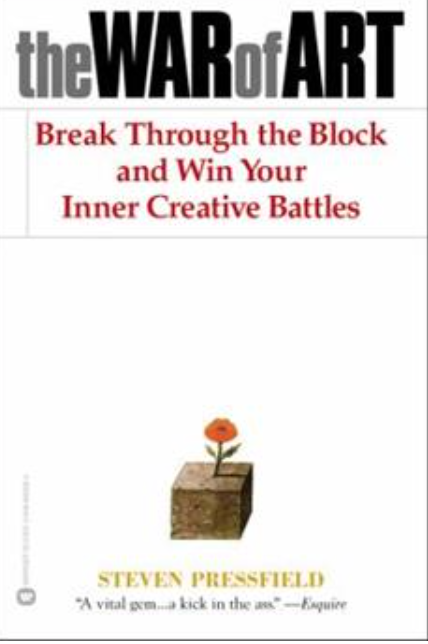
the War of Art

Book Review

I read an amazing book which I’m certain will help you overcome inner resistance- when it comes not only to your health and physique goals, but in nearly any endeavor that comes from our higher nature.

Activities which commonly elicit resistance include:

1. Creative endeavors and callings in the fine arts, writing, music

2. A program of spiritual advancement

3. Education of every kind

4. An act of political moral or ethical courage

5. Any activity whose aim is tighter abdominals, a diet or health regimen or a course or program designed to overcome an unwholesome habit or addiction.

In other words, any act that involves the delay of gratification in favor of long-term growth, health or integrity is likely to be met with resistance.

According to Steven Pressfield, author of the book the War of Art, resistance will tell you anything to keep you from doing your work. “It will purjure, fabricate, falsify; seduce, bully cajole.” However, the rule of thumb is the more important a call of action is to our soul’s evolution, the more resistance we will face pursuing it. Resistance aims to kill our genius; our unique and priceless gift we were put on the earth to give and when we fight it, we’re in a war.

Sometimes resistance takes the form of drugs, shopping, sex, tv, gossip, alcohol, or all products containing fat, sugar, salt or chocolate.

Fear and the degree of fear we have about an endeavor equates to the strength of resistance. If it meant nothing to us, there’d be no fear and no resistance. Yet its the fear that tells us this is what we have to do. This is where our growth is and our potential. Resistance feeds on fear. That is the battle.

Part of overcoming resistance it seems is to acknowledge that its there and prepare for the battle by going pro.. Enlisting help, and also by keeping on the daily task.

Sure we fear failure..but sometimes even more, we fear success. What will we lose on the way to success? It will change our identity. Perhaps success will change our friends. We may become estranged from all we know. Will we end up alone, unmoored? What happens actually is that we do change and we find friends in places we never knew to look, and we become more than we could have imagined.

My takeaway is that this book is about finding and becoming your true authentic self ..and in a city most known for celebrating what’s fake, its something ironically we probably crave the most.

If you are looking for help overcoming resistance and finally achieving the body of your dreams, learning a new fitness skill, or simply enjoying movement, contact me to book a session today.